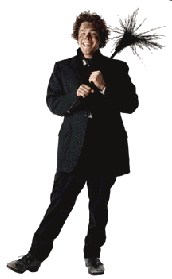
Chim chim cher-ee
|
|
Chim chiminey
Chim chiminey
Chim chim cher-ee!
A sweep is as lucky
As lucky can be!
|
Chim chiminey
Chim chiminey
Chim chim cher-oo!
Good luck will rub off when
I shake hands with you -
Or blow me a kiss
And that's lucky too!
|
|
Now as the ladder
of life
Has been strung,
You may think a sweep's
On the bottommost rung.
Though I spends me time
In the ashes and soot,
In this whole wide world
There's no happier bloke!
|
|
Up where the smoke
is
All billered and curled,
'Tween pavement and stars
Is the chimney sweeps' world.
|
When there's hardly
no day
Nor hardly no night,
There's things half in shadow
And half way in light.
On the roof tops of London -
Coo, what a sight!
|
|
|
I choose me bristles
with pride
Yes, I do!
A broom for the shaft,
And a broom for the flume.
Though I'm covered with soot
From me head to me toes,
A sweep knows he's welcome
Wherever he goes!
|
|
Chim chiminey
Chim chiminey
Chim chim cher-ee!
When you're with a sweep
You're in glad company.
|
Nowhere is there
A more happier crew
Than them wot sings
"Chim chim cher-ee
Chim cher-oo!"
|
On the chim chiminey
Chim chim cher-ee
Chim cher-oo!

|
Do you remember the first time
you saw the movie Mary Poppins? Did you ever wonder about the
mysterious lives of the many chimney sweeps in that movie? The
magic of the scene on the rooftops of London, with chimney sweeps
dancing precariously close to the roof's edge, thrills audiences
of many ages.
Sweeping was begun mostly in England during the
17th or 18th century, where it was the government's wishes that
all flues, or chimneys, be swept often. The chimneys of the period
were very large, so small boys, usually sold into slavery from
orphanages, called "climbing boys" were sent up the
flue to brush away the soot by hand. Often, an older more experienced
boy followed behind. If the new boy slowed down or stopped, the
boy underneath would poke the younger boy's feet with needles.
It was because of this and because many children got stuck and
died in chimneys that narrowed at the top, that the Queen of England
supposedly offered a reward for a better way of cleaning the chimneys.
Thus, the rods and brushes that are still used today came into
use. It is also said that once, one of England's kings had an
incident with his horse, and a chimney sweep gentled the horse
and prevented the king from being thrown to the ground. The king
returned the sweep with a gesture that all sweeps would get one
day off per year, by law.
The traditional outfit of top hat and tails
was worn because wealthy undertakers would give their clothes
away to the sweeps - a very different outfit from the coverings
worn today.
The above lines come from:
http://www.cleanairpro.com/story.htm
|
Midi: Chim Chiminey
Comment or Share Your Own Nursery Rhymes
Print This Page!
|